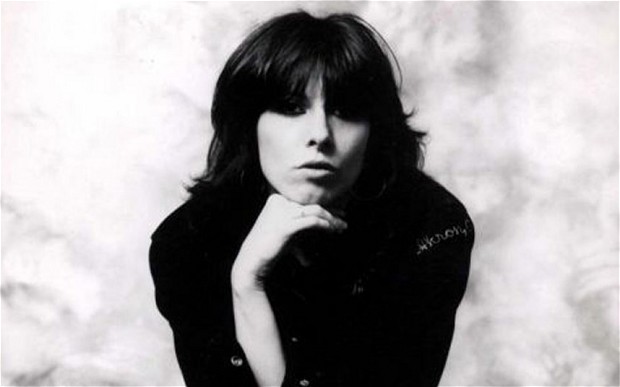
Chrissie Hynde was born in 1951 in Akron, Ohio, but she spent a lot of her time in Cleveland growing up. She was an outsider in high school, basically because no one else was as cool as her, and she saw much bigger things for herself than what was available around her. She spent a lot of her time going to shows in Cleveland, and never dated anyone, because she was too busy being in love with Iggy Pop and Brian Jones (of the Rolling Stones).
She studied art at Kent State University, where she was caught up in the Kent State shootings in 1970, one of the activists shot being the boyfriend of one of her close friends. During this time, she was also in a band with Mark Mothersbaugh (of Devo) called Sat. Sun. Mat., which stood for Saturday Sunday Matinee, but I have unfortunately found no evidence that recordings of this early band exist. It appears they only played one set of cover songs in a church hall in Ohio. Chrissie also was forced to perform sex acts on a man in an Ohio biker gang during this time, when she was 21, and came under fire for how she blamed herself for hanging out with people who did a lot of drugs and were involved in criminal activities.
She moved to London in 1973, and she continued to hang with a lot of bikers, which led to her becoming close friends with Lemmy Kilminster of Motörhead, who eventually helped her piece together the band that would make her famous after many failed attempts in London and Paris over the course of a few years. During her first time in London, however, she met rock journalist, Nick Kent, and began to write what she now describes as “half-baked philosophical drivel and nonsensical tirades” for NME. She worked in the famous store SEX, a center of the punk scene there, and tried to convince both Johnny Rotten and then Sid Vicious (both of the Sex Pistols, in case you’ve been living under a non-punk rock) to marry her in order for her to get a work permit to stay there. Sid Vicious accepted, but the courthouse was closed for a holiday, and Vicious had to make a court appearance the next day. Chrissie left for Paris, where she failed to start a band, and then had to ship back to Cleveland. She went back to France in 1976, failed to start a band again, and so I just want to point out here that Chrissie’s story is definitely one of persistence, and refusing to settle. She had to go back to Cleveland, but then left Kent finally to play with The Frenchies, until she was able to return to London in 1976, at the beginning of the punk scene there. She was determined to start a band this time.
She responded to an advertisement in Melody Maker and auditioned for a band that eventually became 999. She also tried to start a band with Mick Jones (The Clash), but it was not successful, and following that Malcolm McLaren (promoter and manager of The Sex Pistols and New York Dolls, as well as co-owner of the SEX shop Chrissie worked at) placed her as a guitarist in Masters of the Backside; however, Chrissie was asked to leave right before they took off as The Damned. Shit, girl. Fortunately, her good friend, Lemmy, was there to console her when she was feeling discouraged, and gave her a lot of tough love, refusing to let her wallow in her negative emotions resulting from all of these setbacks–which is good, because very few of these other artists would become as successful, culturally important, or revered over the course of time as Chrissie! She did a brief stint in the band Johnny Moped and Mick Jones invited her to join the initial tour of the UK with his band, but had nothing to move forward with when it ended. In 1978, she did a short stint with the Moors Murderers, who were named after a pair of serial child-killers and stirred up a lot of controversy just because of their name, and Chrissie swiftly distanced herself from the group to focus solely on getting her own group together.
It was great, but my heart was breaking. I wanted to be in a band so bad. And to go to all the gigs, to see it so close up, to be living in it and not to have a band was devastating to me. When I left, I said, ‘Thanks a lot for lettin’ me come along,’ and I went back and went weeping on the underground throughout London. All the people I knew in town, they were all in bands. And there I was, like the real loser, you know? Really the loser.
Chrissie Hynde
The Pretenders finally started to come together in 1978. Chrissie gave a demo tape to Dave Hill of Real Records, who started paying her back rent on her rehearsal space, and advised her to take her time and get the right people involved. She first met bassist, Pete Farndon, and they selected James Honeyman-Scott to do guitar and keys and Martin Chambers for percussion. All of them sang. Their demo tape included “Precious,” “The Wait,” and a cover of “Stop Your Sobbing” by The Kinks, and I’m not sure why, because “Precious” is one of the greatest rock songs ever, but it was “The Wait” b/w “Stop Your Sobbing” that were released on their first single. I guess they were probably saving “Precious” to be the phenomonal album opener it very much is on their self-titled debut LP. Here it isssss! As a Cleveland girl myself, I appreciate the fuck out of this song which names my city and streets I remember from my childhood, especially the part where she yells “fuck off!” Also included is the demo version of “The Wait” and “Brass in Pocket,” which was also released as a single before their debut LP was released, and was their first big success. Their debut immediately went to number one in the U.K. and was in the top ten in the U.S., and is widely considered to be one of the most important records of all time (VH1, Rolling Stone) as well as a defining record of the eighties (Slant).
It is worth noting that before 1978, Chrissie Hynde did not really know what her voice sounded like. A true autodidact, she attributed her distinctive time signatures to an inability to count and her amusia (inability to recognize musical tones or reproduce them) to an inability to hear. She says that “distinctive voices in rock are trained through years of many things: frustration, fear, loneliness, anger, insecurity, arrogance, narcissism, or just sheer perseverance – anything but a teacher.” AMEN.
They next released their first EP, literally called Extended Play. The song “Message of Love” quotes Oscar Wilde, and is a statement of the power of love and the importance of standing by each other.
The Pretenders went through lineup changes fairly immediately owing to Honeyman-Scott dying of heart failure due to cocaine intolerance in 1982, mere days after Farndon had been fired from the band. Farndon would also die from a drug overdose. The band reformed in 1983 with Martin Chambers, Robbie Macintosh and Malcolm Foster for the album Learning to Crawl (1984). It was another hit record, and included the popular single they had released in 1982, “Back on the Chain Gang,” as well as “My City Was Gone,” often referred to as “The Ohio Song,” which was only not titled “Ohio” because Crosby, Stills, Nash, and Young had already taken it. It is noted for expressing her growing social and environmental concerns.
The Pretenders have put out twelve albums in total, between 1980 and 2016, with Chrissie being the only consistent member. She also has been involved in countless collaborations with other musicians. Chrissie was inducted into the Rock and Roll Hall of Fame in 2005 for her work with The Pretenders, and she continues to be heralded as a hometown hero and rock and roll pioneer especially greatly in the Cleveland area, and Ohio generally. From 2007-2011, she operated a vegan restaurant in Akron, called VegiTerranean. In 2015, she published her autobiography Reckless: My Life as a Pretender, in which she writes about the difficulties of drugs, single motherhood, and running a vegan restaurant, in addition to her long, difficult, and storied career.
In closing,

Signed,
A Cleveland Rock and Roll Girl
Note: This post is dedicated to Tarra Marie Gimm Sapienza, AKA Tarra Tony Danza–the first real girlfriend I had and the first punk friend that I had, who changed my life forever the day she showed up with her skateboard and unapologetic fierceness in the first days of eighth grade, went with me to my first punk show, and convinced me that I should live in my truth and speak it…even if it is difficult, and even if there are consequences. She is my personal Cleveland punk rock girl hero.

 A WOMAN A DAY TIL BIKINI KILL IN L.A.