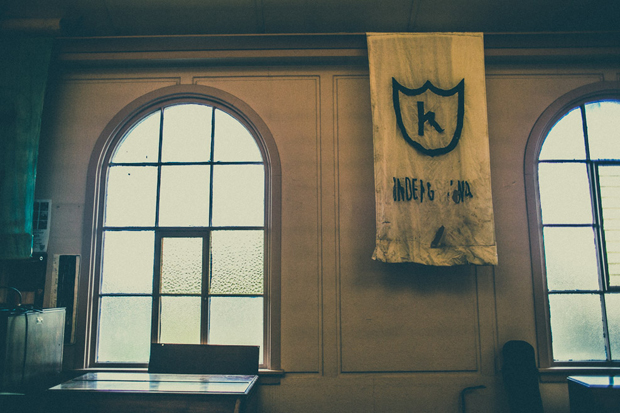
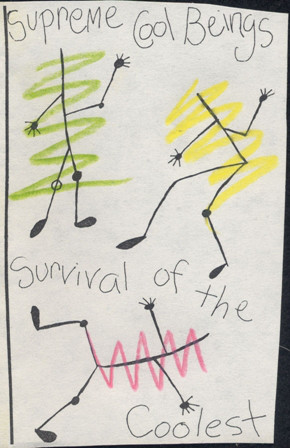
K Records was founded in Olympia, WA, in 1982, with the immediate intention of releasing a cassette of a performance a band called Supreme Cool Beings had done on Calvin Johnson’s radio show on the local station, KAOS FM. The ethos was D.I.Y. (do it yourself), low fidelity, and home-made. It was also very much centered on youth culture, with a stated aim of “exploding the teenage underground into passionate revolt against the corporate ogre worldwide.” The general aesthetic in the beginning was “twee”: childlike themes, hand-drawn album art, general disregard for technical musicianship, primitive recording techniques, and very importantly, a complete rejection of the hyper-masculine hardcore punk ethos of the eighties. As I have stated in previous posts, it was heavily influenced by the softer, more introspective side of UK post-punk bands such as The Raincoats, Young Marble Giants, and Marine Girls. According to Michael Azerrad, a very astute music journalist who wrote the bestselling Nirvana biography, K was “a major force in widening the idea of a punk rocker from a mohawked guy in a motorcycle jacket to a nerdy girl in a cardigan.” This post will discuss the women involved in K Records in the eighties who were an intrinsic part of that shift and laid the foundations for the riot grrrl movement.
Heather Lewis
(Supreme Cool Beings, Beat Happening)

Heather Lewis is a multi-instrumentalist who was a member of The Supreme Cool Beings, who are responsible for the first release on the K Records label, and then became a founding member of Beat Happening. Supreme Cool Beings grew out of (bandmate) Gary Allen May’s apartment being turned into an impromptu rehearsal space. The band was truly the FUTURE MUSIC FUCK SAUCE of Olympia, Washington, featuring male and female vocals, a female drummer, and members who played in multiple bands simultaneously and didn’t take any of it that seriously–all of which were quite unusual in 1982. In a 1983 review of a performance that Ann Powers wrote for The Rocket, they were described as being “kind of sloppy, Heather’s vocals come off sort of flat, and it’s all kind of silly, but that’s really the fun of it.”
Here are some songs they made.
Beat Happening began in 1982, while Heather was still working with Supreme Cool Beings. She began playing with Calvin Johnson and Laura Carter, and this became Beat Happening when Bret Lunsford joined the band. I feel very connected to Heather Lewis, because she was a drummer who didn’t have any drums. It has been said the entire history of the band could be told through whose drums they borrowed for everything they did. If they could not borrow any drums, Heather would make impromptu drum sets out of garbage cans and cardboard boxes. Her role in Beat Happening rotated between drums, vocals, and guitar, and this has been cited as being very inspiring and influential to important future riot grrrl musicians and cultural workers such as Molly Neuman of Bratmobile and Kathleen Hanna (of Bikini Kill, Julie Ruin, and Le Tigre). Beat Happening became leaders of the American twee/indie pop and lo-fi movement, releasing many critically acclaimed albums in the eighties, and becoming one of the most popular indie bands by the release of Dreamy (1991) and You Turn Me On (1992).
One of the things K Records did very early was forge musical partnerships with other like-minded labels. This began with an early distro deal with Rough Trade Records in 1985, and continued with a partnership with Dischord Records in 1989, which resulted in joint releases between the labels on what was called DisKord Records, of Nation of Ulysses and Autoclave’s Go Far (1991). This also led to co-tours between Olympia and D.C.-based punk acts, which directly drove the development of riot grrrl in both places simultaneously. Beat Happening played for very hostile hardcore audiences on tour with Fugazi and opening for Black Flag. Just imagine being a Black Flag fan and going to the venue and hearing this:
Or this!
Or this!!!
Or this?
Or this?!
Or these!?!
So, in a strange way, this very soft band was remarkably confrontational and threatening to the eighties hardcore punk scene by singing songs about innocence, longing, enjoying simple things, and crying by yourself. Sing us out with something sweet and heartfelt, Heather…
Tobi Vail
(The Go Team, Bikini Kill, Some Velvet Sidewalk, The Frumpies, Spider and the Webs, The Old Haunts)

Tobi Vail is most well-known for her work as the drummer of Bikini Kill and a crucial force in the riot grrrl movement–and for being the the girl many Nirvana songs are about–but she has been in many other bands before and since. Born in Auburn, Washington, in 1969 to teenage parents, she moved to Olympia by the time she was in high school. Both her father and her grandfather were drummers. At age fifteen, she immediately began volunteering at KAOS Radio at Evergreen State College and getting exposed to the independent music that was a focus there, largely due to the pioneering work of John Foster’s Lost Music Network and OP magazine. Tobi served on and off as a DJ there from age fifteen to twenty-one.
Tobi was actually on the K Records label in 1985 as a part of The Go Team with Calvin Johnson. They released several cassettes and nine singles, as well as touring the west coast in 1987, and completing two U.S. tours in 1989. At this point, they disbanded, and Tobi drummed for Some Velvet Sidewalk and toured with them in 1990. Here is a selection of her early work on the K label.
Tobi had been trying to start an all-girl band “to rule the world and change how people view music and politics,” including a band called Doris with Cheryl Harper and Tamra Ohrmund, whose work never saw release. She would become connected with Kathleen Hanna through her feminist zine, Jigsaw, which focused heavily on girls in bands, and finally realize her dreams with Bikini Kill, who we will discuss AT LENGTH in exactly…ten days! Tobi continues to work as a musician, music critic, and feminist activist.
Candice Pedersen
(Co-owner of K Records, 1986-99; Organizer of the International Pop Underground Convention of 1991)
Candice Pedersen was initially hired as an intern at K Records in exchange for twenty dollars a week and credit at Evergreen State College. By 1986, she had created her own spot as a co-owner, and became a full partner in the label by 1989. She organized the International Pop Underground Convention of 1991, which was a huge public party that featured many amazing bands, such as: Fugazi, Bikini Kill, Built to Spill, The Melvins, Some Velvet Sidewalk, L7, Unwound, and Beat Happening. She was also directly responsible for the opening night event, “Girl Night: Love Rock Revolution Girl Style Now.” It featured femme punk and queercore bands exclusively: Bikini Kill, Bratmobile, Lois Maffeo’s early band “Courtney Love,” Jean Smith of Mecca Normal, Kicking Giant (feat. Rachel Carns of The Need), 7 Year Bitch, and Heavens to Betsy (feat. Corin Tucker pre-Sleater-Kinney). This event was really the beginning of the riot grrrl movement, and Candice Pedersen is the person you have to thank for organizing it! The IPU Convention was included in the exhibit Revolution You Can Dance To: Indie Music in the Northwest at the Washington State History Museum in 2016-17. Spin magazine has called it “the Woodstock of the Nineties,” but we think they are overestimating the cultural value of Woodstock over here at A WOMAN A DAY TIL BIKINI KILL IN L.A.
Jean Smith
(Mecca Normal)
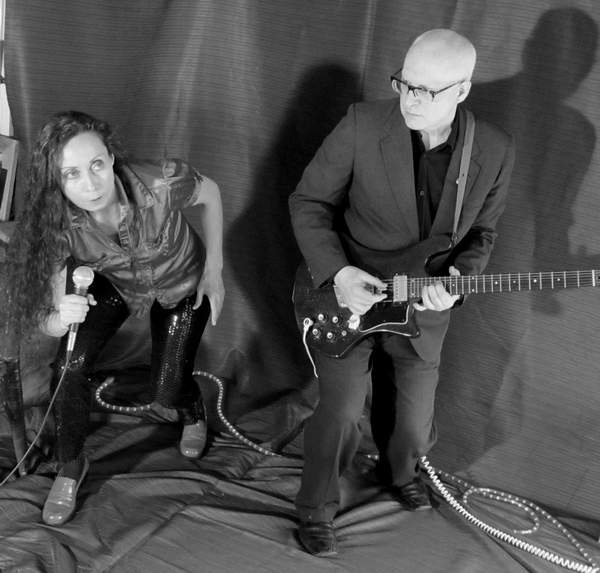
Well, I was already starting to feel like a legitimate music journalist when Chris Frantz from Talking Heads told me he liked my post about his partner in music and life, Tina Weymouth, and connected with me on social media. I began to think it would be pretty cool to have a blurb from Chris Frantz on a book I wrote. Then, yesterday, Jim DeRogatis told me he thinks my blog is cool and would make a great book and that he would love to talk to me about it once he is less busy with the release of his book documenting the past twenty years he has spent tirelessly reporting on R. Kelly and refusing to let people bury the truth about his serial sexual abuse of young women. WHAT?! Yeah! The very famous music journalist, Jim DeRogatis. And THEN, Jean Smith from Mecca Normal added me on Facebook and was eager to talk to me about women active in the K Records scene in the eighties. I DID NOT EVEN WRITE TO HER! I wrote to Chris Frantz and Jim DeRogatis. Somehow my post on Tracey Thorn got very widely circulated, and now musicians I deeply respect and admire are out here trying to support my research. What a world. So! Shout out to Jean for her generosity and dedication to preserving this history and helping me get it right! I cannot wait to investigate it more thoroughly in book form and pick her brain even further, when I have more time!
Jean Smith is a musician, author, painter, lecturer, and filmmaker! She is one half of the band Mecca Normal, who were formed in Vancouver, B.C., in 1984, after her and David Lester met working at a newspaper there. Jean writes lyrics that are confrontational and laced with feminist and anti-authoritarian themes, in which social justice issues factor heavily, and the personal being political is made very clear. Jean’s pioneering work in Mecca Normal helped define the sound and spirit of the early riot grrrl movement.
Mecca Normal’s first record was self-released on their own label, Smarten Up!, in 1985. They later merged this label with David’s small press publishing company, Get To The Point, on which Jean has released a number of books. They released their first record on K in 1986, after they met Calvin at their Black Wedge show in Olympia, where they traded him one of their records for a Beat Happening one. (The Black Wedge was a U.S. tour of anti-authoritarian musicians and poets.) They released five records on K between 1986 and the early nineties, but they also released on many of the other largest indie labels of the nineties: Matador, Kill Rock Stars, and Sub-Pop. Most recently, they released Empathy for the Evil (2014), on a label that is dear to my heart and home to many bands I love, M’Lady’s Records. They toured with Go Team and Some Velvet Sidewalk in 1990 and Jean’s performance at Girl Night is cited by many women central to riot grrrl as an inspirational one.
Books by Jean include:
- I Can Hear Me Fine (1993)
- The Ghost of Understanding (1998)
- The Family Swan and Other Songs (2002)
- Two Stories (2006)
In 2016, they toured with Kathleen Hanna’s most recent band, The Julie Ruin! Jean and David have been presenting in universities , high school classrooms, art galleries, indie media outlets, book stores, rock venues, and youth centers on the topic of “How Art and Music Can Change the World” since 2002. Here are some examples of their own world-changing art and music.
Lois Maffeo
(Lumihoops, “Courtney Love” (the band), Lois)

Lois Maffeo is a musician and writer born in 1963 and raised in Phoenix, Arizona. While she never achieved mainstream success, she was closely involved in and very influential to many independent musicians, especially in the nineties Olympia, Seattle, and D.C. music scenes. She didn’t start playing guitar until she was 24, when she was inspired by minimalist bands like Marine Girls and Young Marble Giants as well as a poster she believes was advertising The Damned which illustrated three chords–D, A, and G, and said “now start a band!” She decided to actually pick up the guitar she had bought just because it was beautiful. She contributed an unknown track to an early K cassette compilation called Dangerous Business International (1985) and appeared again singing on the song “My Head Hurts” with the Go Team on the Archer Come Sparrow (1988/89) cassette. She is an important part of the connection between K and Dischord Records and their respective music scenes. She says that while the labels produced very different music, they were spiritually and philosophically connected through their commitment to independence, honesty, and ethics. Ian MacKaye actually produced tracks for her, and she has also collaborated with Brendan Canty (the drummer of Fugazi, and one of my favorite drummers ever–in fact, my future drum set is going to have a farm bell in his honor.) Lois also had an all-girl radio show called “Your Dream Girl” on KAOS radio. While not sonically close to riot grrrl, she was geographically close to the movement as it developed contemporaneously on both coasts, and had been interested for many years in women making music and very supportive of it. Her influence is much greater than her commercial success, which is basically true for K on the whole as a label; being commercially successful was never the point. (While some artists who worked with K did find mainstream success–Beck, Modest Mouse, Built to Spill–they did so on other labels.)
What was the point? Well, to build an independent music culture in which literally anyone could participate. Considering the long history of oppression and exploitation in the music industry I have documented here over the past months, I think you’d be hard-pressed to argue that wasn’t very revolutionary. Find some songs from her various music projects below!
I think riot grrrl seems to be a movement that kind of created outside of what really happened. I think what really happened is people began to feel more self-confident and met in groups of people where they felt safe to talk about different issues.
Lois Maffeo
For more information on these topics, I recommend The Shield Around the K (2000), a documentary about K Records, and the books shown below!


Oh, and here is a picture from when I flew to France when I was eighteen to perform at a festival with a number of members of the K Records Class of 2005:


 A WOMAN A DAY TIL BIKINI KILL IN L.A.
One thought on “11 DAYS TIL BIKINI KILL IN L.A.: The Women Behind the ‘K’”